
Keyword research should do more than produce a list of search terms. It should reveal what potential customers search for, how competitive those searches are, and which opportunities deserve priority.
Chowdhury SEO Consulting provides research-driven keyword research services built around search demand, intent, competitors, website performance, and business priorities. We identify keywords that can support qualified traffic, clearer page targeting, and organic growth
Tell us about your business and what you want to achieve.
Your information is kept private and will only be used to respond to your inquiry.

Many websites struggle because their SEO strategy starts with the wrong keywords.
A high-volume term may bring visitors with little commercial value. In other cases, businesses create pages around keywords that do not match the intent Google is rewarding.
Common problems include:
Targeting traffic instead of business value
Choosing keywords that do not fit the page
Missing valuable competitor terms
Creating several pages around the same intent
Publishing content without keyword mapping
Relying on difficulty scores without reviewing the SERP
Keyword research helps turn these problems into a clearer search strategy.
We identify commercial, informational, navigational, and supporting queries connected to your products, services, customers, and market.
We evaluate what searchers want and what type of page is most likely to satisfy that intent.
We analyze the keywords competing websites rank for, which pages drive their visibility, and where gaps exist
We review ranking pages, authority, SERP features, and competitive strength instead of relying only on a tool-generated score.
We identify valuable topics and search terms competitors cover but your website does not.
Related terms are grouped by topic and intent, then assigned to the most appropriate existing or future page.
Keywords are prioritized by relevance, intent, competition, search demand, website authority, and commercial potential.

Effective keyword research starts with the business, not the SEO tool.
Before recommending target terms, we study what you sell, who you serve, which actions matter most, and how your website currently performs.
Our research may include:
We do not select keywords simply because they have high search volume. Each target must fit the customer journey, competitive environment, website structure, and business strategy.
01
We understand your services, customers, target markets, goals, conversion priorities, and website structure.
02
We investigate how customers search for your products, services, problems, and solutions while reviewing what currently ranks
03
We identify search competitors, their ranking keywords, strong pages, topical coverage, and missed opportunities.
04
Potential terms are evaluated by intent, relevance, competition, search demand, SERP conditions, and commercial importance.
05
Closely related queries are grouped so pages can target complete topics rather than isolated keyword variations.
06
We determine whether an opportunity belongs on an existing page, new service page, location page, category page, landing page, or informational resource.
07
Research is organized into an actionable plan showing which opportunities deserve attention first
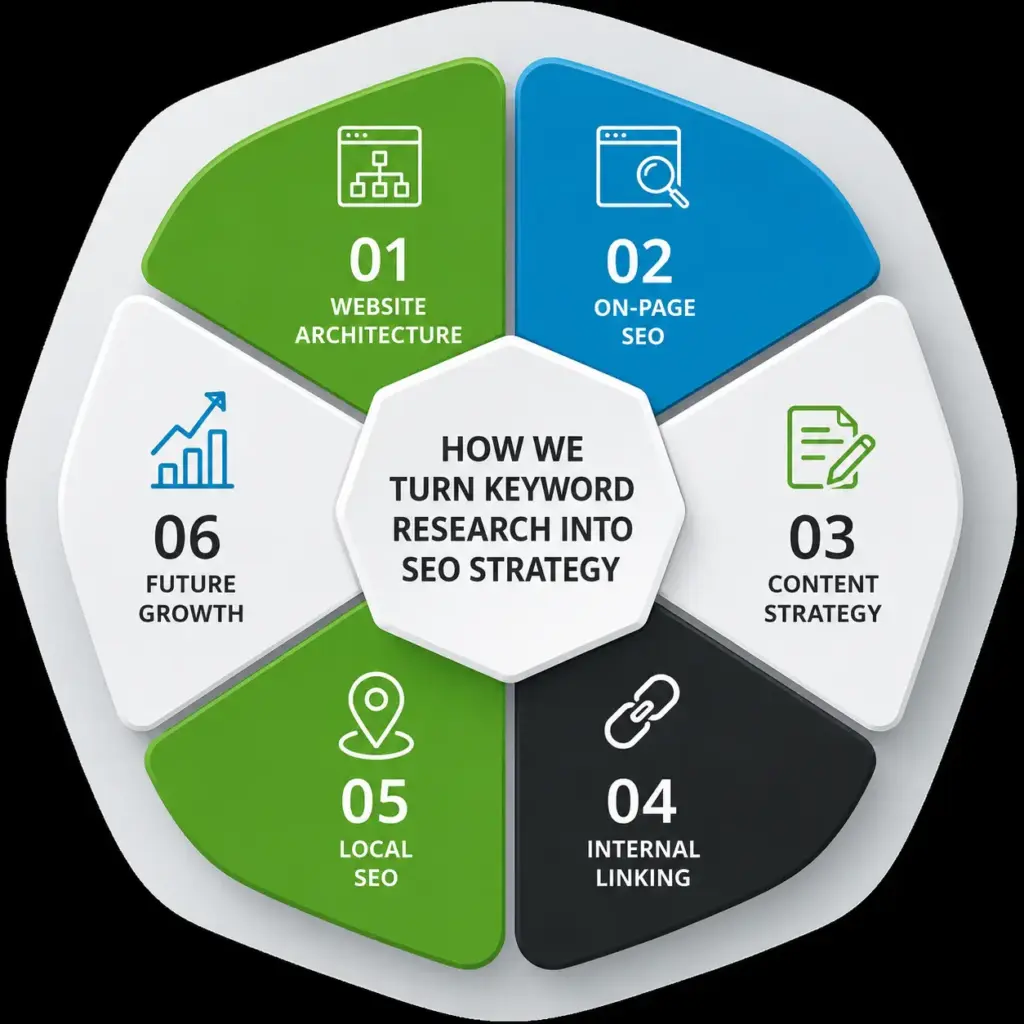
Keyword research becomes valuable when it influences real website decisions.
Determine which service, product, category, or location pages should exist.
Define the primary topic, supporting terms, and intent of each page.
Identify customer questions, informational gaps, and supporting topics worth developing.
Show how related pages should connect and reinforce important subjects.
Reveal service-and-location opportunities with genuine demand.
Separate immediate opportunities from longer-term targets. The result is a search opportunity framework that guides SEO execution.
We understand the business before choosing target terms.
A lower-volume keyword with clear commercial intent may be more valuable than a broad phrase.
Tools help, but actual search results show what it takes to compete.
We prioritize searches that can support meaningful visitors, enquiries, leads, or sales.
Important keywords should have a purpose, destination, and role within the wider SEO plan.
Keyword research supports Technical SEO through site planning, On-Page SEO through page targeting, Content SEO through topic development, Local SEO through location-specific demand, and SEO audits through opportunity discovery.
When research connects these areas, SEO becomes easier to coordinate and prioritize.


Well-planned keyword research can help businesses:
Attract more relevant organic visitors
Give important pages clearer search targets
Reduce keyword cannibalization
Identify competitor opportunities
Build more useful content plans
Prioritize SEO resources effectively
Align search visibility with business goals
Keyword research does not guarantee rankings, but it creates a stronger foundation for informed SEO decisions.

Chowdhury SEO Consulting approaches keyword research as part of a wider growth strategy.
Our recommendations are shaped by competitor intelligence, search intent, website performance, market opportunities, and commercial importance. We create a practical roadmap that can guide content, on-page optimization, website structure, local targeting, and future SEO growth.
The goal is not the longest keyword list. It is identifying the search opportunities that deserve action.
Keyword research identifies and evaluates the terms people use when searching for products, services, information, or solutions relevant to a business.
It helps reveal search demand, customer intent, competition, and which pages or topics deserve SEO attention.
We consider relevance, search intent, competition, SERP conditions, search demand, website authority, and potential business value.
Both can matter. The right choice depends on intent, competition, relevance, and realistic business potential.
It analyzes the keywords and pages driving competitors’ search visibility to identify strengths, gaps, and opportunities.
Keyword clustering groups related searches by topic and intent so one page can target a coherent search theme.
Keyword clustering groups related searches by topic and intent so one page can target a coherent search theme.
Some overlap is natural, but unnecessary duplication can create cannibalization. Clear keyword mapping helps reduce that risk.
A stronger SEO strategy starts with understanding where real search demand meets your business goals.
Chowdhury SEO Consulting combines business analysis, search intent research, competitor intelligence, keyword qualification, and page mapping to build a practical keyword strategy for sustainable growth.