
A website can lose search visibility for dozens of reasons. Technical problems, weak content, poor internal linking, incorrect indexing, declining authority, competing pages, or changes in search behavior can all affect performance.
Chowdhury SEO Consulting provides in-depth SEO audit services designed to find the issues that matter, identify missed opportunities, and turn the findings into a clear plan of action.
We do not deliver a long automated report filled with warnings your team does not know how to use. Our SEO audit connects technical findings, content performance, search demand, competitors, website structure, and business priorities so you can understand what needs attention first and why.
Tell us about your business and what you want to achieve.
Your information is kept private and will only be used to respond to your inquiry.
Some SEO issues are obvious. Others quietly reduce performance for months before they are noticed.
A website may receive less organic traffic even though no major changes were made. Important pages may stop appearing for valuable searches. Google may index URLs that should not compete with core pages. Strong content may exist but receive little internal support. Several pages may target almost the same search intent.
Businesses often respond by publishing more content or adding more keywords. That can create additional problems when the real issue has never been diagnosed.
An SEO audit gives you a clearer picture of what is happening before more time or budget is invested.

We review how search engines access, crawl, render, and index your website. This may include crawl errors, indexation, robots directives, XML sitemaps, canonicalization, redirects, duplicate URLs, status codes, mobile performance, Core Web Vitals, structured data, and technical site architecture.
We evaluate page titles, headings, content relevance, keyword targeting, search intent, images, internal links, and other page-level signals that help search engines understand your content.
A page can be technically correct and still underperform.
We examine whether important pages genuinely answer the search intent behind their target terms, whether content is outdated or repetitive, and whether useful topics or commercial opportunities are missing
We review how pages are organized and connected.
This helps identify important pages that are buried too deeply, weak internal-link relationships, competing URLs, unnecessary complexity, and opportunities to create stronger topical pathways through the site.
We assess the quality and relevance of external links pointing to your website, lost-link opportunities, potentially harmful patterns, competitor authority, and areas where your brand may need stronger external signals.

Finding errors is only one part of an SEO audit.
We also need to understand what the website could be achieving.
That means reviewing your market, competitors, current rankings, search demand, important products or services, existing content, and the types of queries potential customers use when they are looking for solutions.
We look at where competitors are gaining visibility, which pages drive their search presence, where your website already has momentum, and where realistic opportunities exist.
This prevents the audit from becoming a purely technical exercise.
The purpose is to identify both what is wrong and what can be improved to create growth.
01
We begin with your website, business model, services, target customers, current SEO activity, and growth priorities.
This gives the audit commercial context.
02
We investigate crawlability, indexing, page performance, site structure, content, internal links, organic visibility, and other factors that can influence search performance.
03
We compare your website with relevant search competitors to identify gaps in content, authority, keyword targeting, website structure, and visibility.
04
Not every SEO issue deserves immediate attention.
We separate critical problems from lower-impact improvements and organize recommendations according to expected impact, urgency, effort, and dependency.
05
The final recommendations explain what should be fixed, improved, consolidated, created, or monitored.
Your team should leave the audit knowing what to do next not simply knowing that problems exist.

An SEO audit becomes valuable only when the findings can be implemented.
Depending on what we discover, the next steps may include correcting crawl or indexation problems, restructuring internal links, consolidating competing pages, improving content, rebuilding page targeting, fixing redirects, strengthening important landing pages, improving site architecture, or developing new content around missed search opportunities.
Where development or content teams are involved, recommendations can be organized so each team understands the work relevant to them.
This reduces wasted effort and helps implementation happen in the right order.
Many SEO audits start with software and end with an exported list of errors.We use tools, but tools do not make the final strategic decision.A warning only matters when we understand its effect on the website, the search opportunity, and the business.
Our approach focuses on:
Research before recommendations
Business impact instead of issue counts
Manual review alongside technical data
Competitor context
Search-intent analysis
Clear prioritization
Practical implementation guidance
We also evaluate whether the website is structured clearly enough for modern search environments, including traditional Google results and AI-assisted discovery.
The objective is not to chase every new search feature. It is to create a technically sound, well-organized, authoritative website that search systems can understand more easily.
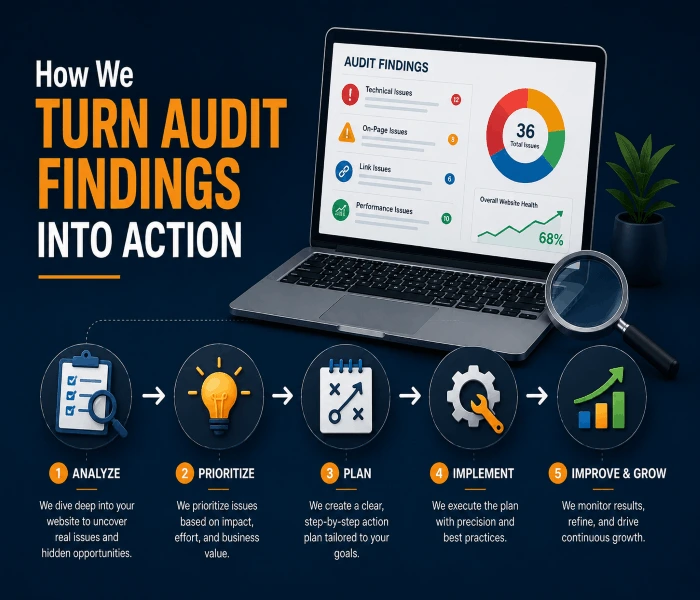
A strong audit can help businesses improve far more than technical health.
Depending on the problems identified, the work may support:
The audit itself does not create growth. The value comes from making better decisions about what should be fixed and where resources should be focused.

An SEO audit can be especially useful when
Even websites that currently perform well can benefit from periodic audits because technical conditions, competitors, content quality, and search behavior continue to change.
A professional SEO audit can include technical SEO, indexation, crawlability, website architecture, on-page optimization, content quality, internal linking, backlink analysis, competitor research, keyword opportunities, and prioritized recommendations.
The exact scope should depend on the website rather than a fixed checklist.
Automated tools are useful for collecting data and identifying possible issues, but they cannot fully judge business value, search intent, competitive context, or which recommendations deserve priority.
Manual analysis is necessary to turn audit data into strategy.
Implementation can be handled separately depending on the project. The audit itself provides a structured roadmap so technical, content, and optimization work can be planned in the right order.
The right frequency depends on the size of the site and how often it changes. Large, active, or highly competitive websites may require more frequent reviews, while smaller sites may need a comprehensive audit after major changes or when performance problems appear.
Before investing in more content, links, technical development, or new SEO campaigns, it helps to know where your website actually stands.
Chowdhury SEO Consulting will examine your current search performance, identify the issues limiting growth, research opportunities, and organize the findings into practical priorities.
A good SEO audit should give you more than a list of errors.
It should give you clarity about what is happening, what matters most, and what your business should do next.